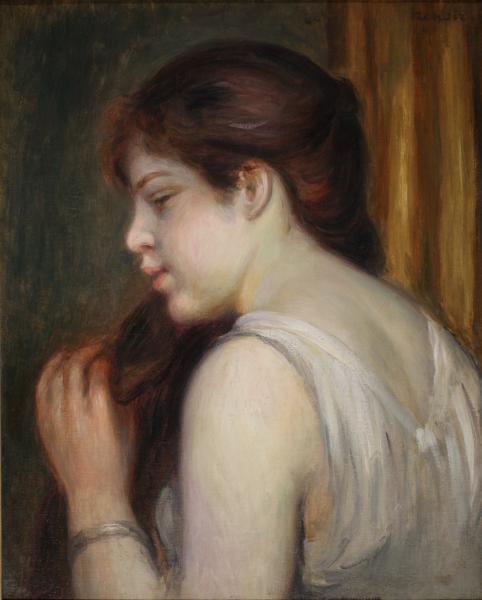
Jeune fille se peignant, 1892-94
Oil on canvas, signed upper right.
46 x 37.50 cm
Provenance :
William Martin, London
Alex Reid & Lefèvre Ltd., London, acquired from the above on 11 January 1936
Galerie Étienne Bignou, Paris, acquired from the above on 18 April 1936 (titled Buste de jeune fille)
Morris Gutmann (French Art Galleries, Inc.), New York
Henry J. Leir, New York, acquired from the above in 1952
Sotheby’s sale, London, 24 June 1996, lot no. 28, p. 34, ill. p. 35 and dated 1891
Estate of Henry J. Leir
Sotheby’s sale, New York, 12 May 1999, lot no. 227, p. 34 (colour ill. p. 35 and dated 1891–1892)
Sotheby’s sale, New York, 4 May 2005, lot no. 150, p. 64 (colour ill. p. 65)
Private collection, Suisse
Exhibitions:
• Collection David et Ezra Nahmad. Impressionnisme et audaces du XIXe siècle, Musée Paul Valéry, Sète, 29 June – 27 October 2013, no. 26, ill. pp. 10, 107, 110, 252.
• Modern Masters: from Rembrandt to Picasso – Representation of the Figure in Western Art, Sotheby’s Hong Kong Gallery, 2014.
• Paul Valéry et les peintres : Courbet, Manet, Morisot, Degas, Monet, Renoir, Matisse, Picasso..., Musée Paul Valéry, Sète, 25 September 2020 – 25 April 2021, no. 33, ill. p. 125.
• La Collection Nahmad. De Monet à Picasso, Musée des Impressionnismes, Giverny, 28 March – 29 June 2025, no. 34, pp. 68, 69, 118.
Related work:
Young Girl in Left Profile
Pastel and charcoal on cream laid paper mounted on canvas, 58.5 × 45 cm.
Collection of the Musée d’Orsay, Paris (accession no. REC 56).
Certificate of inclusion in the artist’s digital catalogue raisonné issued by the Wildenstein Plattner Institute.
Combing or braiding her long hair, the young woman who serves as the model for our painting is revealed through a gesture of everyday intimacy. Before going to bed, in her déshabillé, probably before a mirror, she performs one of the final rituals of a woman’s day—one of the most private—into which the painter is quietly admitted.
By tightening the framing around her bust, following the graceful line of shoulder and nape and nearly effacing the background, Renoir heightens the sense of intimacy. An intimacy that is shared rather than stolen, conveyed in a softness also suggested by the formal handling of the work, which recalls the effects of pastel.
At the beginning of the 1890s, Renoir had definitively moved beyond his so-called “Ingresque” period and allowed himself greater spontaneity, seeking to reconcile drawing with the materiality of flesh. The skin thus becomes a field of chromatic experimentation. Its whiteness is overlaid with pinks, greens, and oranges, building through successive layers toward a sensuous physical presence. Shadows play a subtle role in shaping and modeling the form.
The illness that would later confine him to a wheelchair, and from which he would suffer acutely during the final two decades of his life, had not yet manifested itself.
This is a transitional moment in his career, preceding a more expansive and monumental phase, yet one that also condenses what is most moving in Renoir’s art: a muted delicacy that defines it, a painting executed with a velvet touch.
The female figure—often shown in half-length—is especially prevalent during these years. Most often depicted in a state of quiet withdrawal, she embodies a form of inwardness that excludes classical solemnity while nonetheless suggesting a sense of permanence, as though time itself had paused to contem- plate this small, ordinary moment of life—essential, however, to the beauty of days.
We do not know the identity of the model. She can be recognized in a preparatory pastel now preserved in the Musée d’Orsay, whose context remains unknown, having been recovered in Germany after the war and entrusted to the care of the French national museums.
Yet the identity of the model matters little: she is not the subject here, but rather the medium—the vehicle that leads us, through the gentle inclination of her neck, her soft and delicate profile, and her half-closed eyes, toward a sensuous and grateful meditation on the beauty of life’s simplest things.